Published: 10/03/2026
Guide to Choosing the Right Compressor System
Not all air compressors are built for the same purpose. While some can withstand 24/7 duty cycles, other compressors are only made for small, hobbyist tasks and to power small pneumatic tools.
Air Supply Manchester designs entire compressor systems for industrial processes. We work with specialist BOGE compressors, but supply and service a whole range of other models.
This guide will inform you about the different air compressors on the market and what they’re used for. If you’re interested in purchasing a compressor or designing a bespoke system, please get in touch.
How do air compressors work?
An air compressor is a system that draws in atmospheric air, compresses it to a higher pressure, and delivers it for its intended use (e.g. power tools or equipment). These machines are available in a wide range of designs, each developed to meet particular operational needs.
The different types of air compressors
Not sure which compressor to buy? Here are some of the most common types and their features:
Note: It is always best to consult a compressed air engineer before purchasing. They are the experts for a reason.
Screw compressors
Compression method
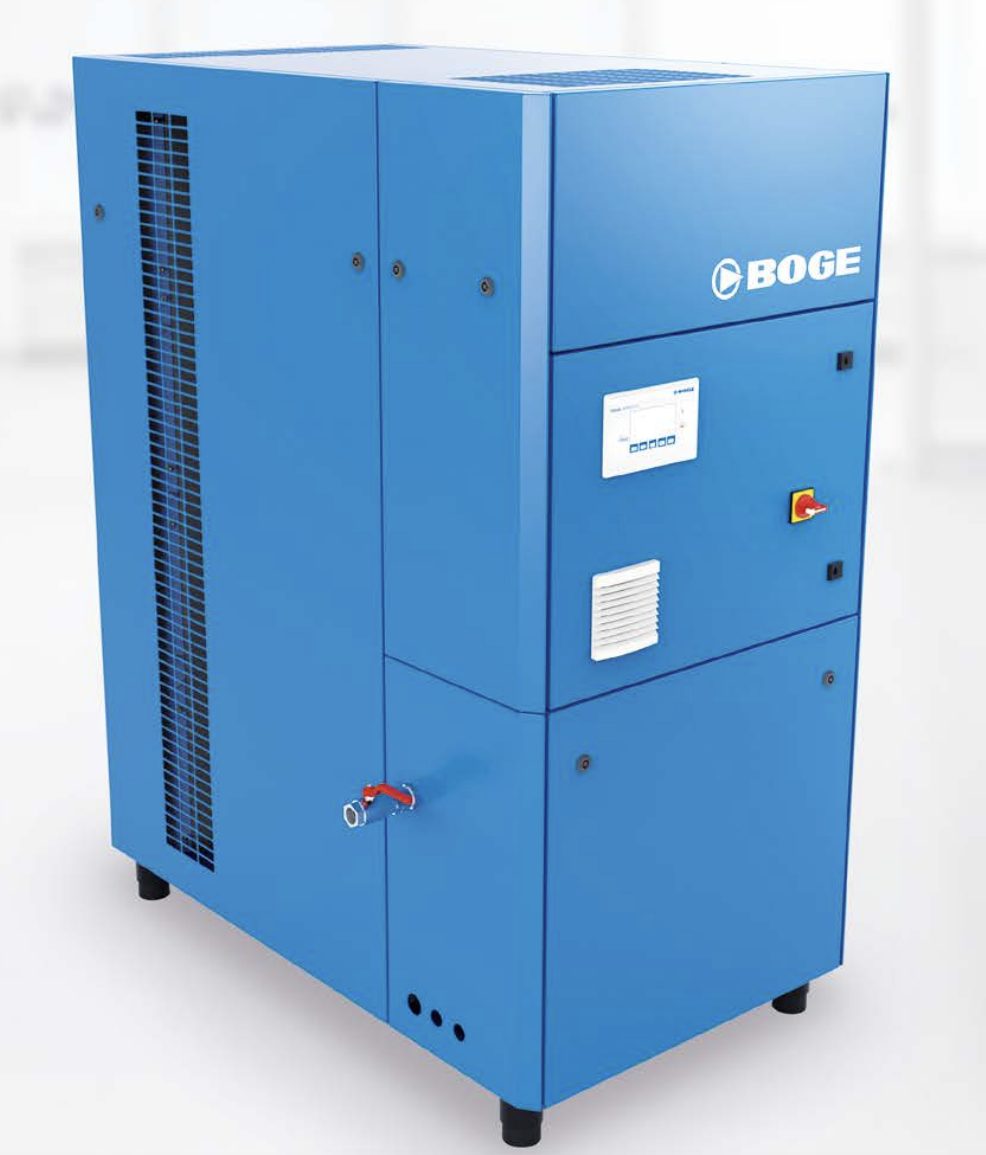
Screw compressors use two interlocking helical rotors (male and female) inside a housing to compress air. As the rotors move, air becomes trapped between the rotor threads and compresses. The speed is optimised by the operator to minimise mechanical failure and downtime. The good news is that it’s also one of the easiest compressors to maintain.
Typical capacity
Screw compressors are capable of providing high volumes of compressed air. Therefore, it’s best suited for environments of high demand (such as peak workloads or multiple tools working simultaneously).
Duty cycle
One of the main advantages of screw compressors is their ability to operate at a near 100% duty cycle. Therefore, they’re suitable for around-the-clock operation, without the risk of breaking down due to being overloaded.
Noise
Screw compressors are fairly quiet with minimal vibration. This is especially the case when housed in a sound-insulated enclosure, thanks to their rotary motion.
Air quality
Most screw compressors are oil-injected. While this makes the system more efficient for its operational processes, it also means some form of air filtration is required if clean or oil-free air is needed for certain industries.
Scroll compressors
Compression method
A scroll compressor (also known as a spiral compressor) uses two spiral-shaped scrolls that are bolted together to compress air. This machine contains one scroll that remains stationary while the other moves in an orbital motion – otherwise known as positive displacement. As air enters the space between the scrolls, it’s gradually pushed toward the centre and compressed
Typical capacity
Scroll compressors typically provide moderate air capacity. However, it’s worth noting that they cannot match the higher volumes of screw compressors. With this in mind, they wouldn’t be suitable for continuous use. Instead, they’re best for applications where controlled airflow is needed.
Duty cycle
As mentioned above, scroll compressors can operate on a continuous basis, but for moderate loads, as opposed to heavy-duty processes. Therefore, they allow for long periods of operation without the risk of overheating or wear and tear.
Noise
One of the major benefits of scroll compressors is that they’re almost silent whilst in operation. This is all down to the fact that they have fewer moving parts and a smooth orbital compression motion. As such, they’re the best for quieter environments, such as medical facilities.
Air quality
Most scroll compressors are oil-free. Therefore, they’re most commonly used in industries where ISO 8573-1 Class 0 oil-free air is required. The good news is that because they produce 100% clean air from being oil-free, very little filtration is needed in comparison to other compressor types.
Piston compressors
Piston compressors have been in operation as far back as the 18th century, and are therefore the oldest compressor type on the market.
Compression method
This system uses a moving piston inside a cylinder to compress the air and reduce its volume. This technique could almost be compared to the way in which an engine piston operates.
By repeatedly drawing air into the cylinder and compressing it, the system generates pressurised air that’s stored in a tank, ready to use for tools and equipment. On the market, you’ll discover both single-stage and double-stage piston compressors, which are both used for different applications.
Typical capacity
They typically offer low to moderate capacity, making them suitable for smaller operations such as car garages/workshops and construction environments.
Duty cycle
Piston compressors are built for intermittent use of up to 60%, as opposed to continuous use. Therefore, they’re not advised for around-the-clock operations.
Noise
Due to the mechanical motion of the piston and valves, this type of compressor tends to produce more noise and vibration than other compressor types. Therefore, it may not be the most suitable option for noise-sensitive environments.
Air quality
Piston compressors are available in both oil-lubricated and oil-free versions.
Oil-lubricated piston compressors use oil to reduce friction between internal components. However, because oil is involved in the compression process, small traces can sometimes enter the compressed air – meaning it’s not 100% pure. In some environments, such as garages and construction sites, this is not a major issue. However, it’s not deemed acceptable in medical or food environments.
Oil-free piston compressors, on the other hand, operate without oil in the compression chamber. Instead, they rely on specialised coatings to reduce friction. These are most commonly found in environments where clean air is critical.
Oil-free compressors
Compression method
Oil-free compressors are engineered to operate without oil in the compression process. They work by taking in ambient air, compressing it and delivering pure air that’s free from contamination or particles.
Typical capacity
The air capacity of oil-free compressors varies depending on the design. Oil-free piston compressors typically provide low to moderate output for light industrial use, while oil-free screw compressors can deliver high volumes suitable for continuous industrial operations. Oil-free scroll compressors offer moderate airflow for applications such as healthcare facilities.
Duty cycle
Similarly, oil-free compressors have varying duty cycles, depending on the type. Screw and scroll designs often support near-continuous operation, while piston models are generally used for intermittent workloads.
Noise
Noise levels in oil-free compressors also differ between types and models. Scroll compressors are extremely quiet, while screw compressors emit moderate noise levels. Piston compressors tend to be the loudest, due to their traditional mechanical internal movements.
Air quality
Oil-free compressors deliver 100% clean air, which is critical in industries such as pharmaceuticals and food and beverage production.
Which air compressor do I need?
If you know you need a compressor system, it’s not worth the stress of figuring out what you need when an expert team can help you.
Air Supply Manchester specialises in the design and installation of BOGE air compressor systems, assisting with servicing and ongoing maintenance. Think of us as your trusted air supply partner in the North West; we are an official BOGE Platinum Partner.
Please get in touch with our team by calling +44(0)161 5183440, emailing sales@airsupplymanchester.co.uk, or filling out our contact form. We’d be happy to discuss your requirements.